dSDR module
An M.2 advanced direct-sampling SDR with phase-coherent 6 RX and 4 TX channels. The direct sampling architecture eliminates RX/TX LO leakage and RX/TX IQ imbalance issues, providing better overall linearity, superior phase noise, a more compact design, and greater flexibility.

An M.2 embedded SDR with 6 RX / 4 TX channels and a frequency range of up to 12 GHz.
General Specifications
- FPGA
AMD Artix UltraScale+ XCAU15P
AMD Kintex UltraScale+ XCKU5P
- Power Consumption
6-15W Typical (depending on the number of active channels and bandwidth)
20W Max
- Interface
M.2 3080 M key PCIe 4.0 x4 (with debug USB2 interface)
100GbE option (for XCKU5P only)
- Extended Power Supply Range
2.85 - 5.5 V
- External Clock Synchronization
Synchronize multiple boards for a massive MIMO array
RF Specifications
- RFIC
AFE7900 / AFE7901 / AFE7950
Frequency Range
Model |
AFE |
FPGA |
Frequencies |
100GbE |
PCIe |
RX |
TX |
|---|---|---|---|---|---|---|---|
1B03 |
7903 |
XCAU10P |
10-7400 |
no |
4.0 |
2 |
2 |
1A01 |
7901 |
XCAU15P |
10-7400 |
no |
4.0 |
4 |
4 |
1A00 |
7900 |
XCAU15P |
10-7400 |
no |
4.0 |
6 |
4 |
1A50 |
7950 |
XCAU15P |
600-12000 |
no |
4.0 |
6 |
4 |
1K50 |
7950 |
XCKU5P |
600-12000 |
yes |
3.0 |
6 |
4 |
- Sample Rate
0.1 MSps - 500 MSps (up to 1 GSps on request)
- Channel Bandwidth
0.5 MHz - 500 MHz (up to 1 GHz on request)
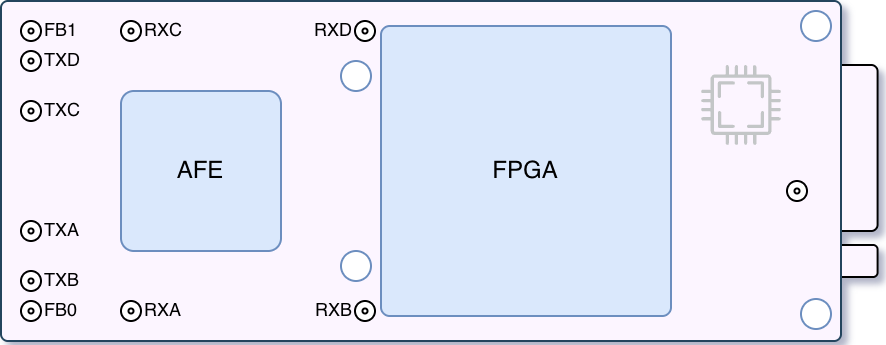
Pinout
Target Applications
- Cellular Communication
Enables next-generation 5G/6G wireless networks with high-order massive MIMO
Fully compatible with Amarisoft and srsRAN
- Massive MIMO Radio Link
With the dMASS synchronization board, it’s easy to build 32×32, 64×64, and larger MIMO systems
- Embedded Applications
Develop compact and high-performance frequency analysis devices
- Data Link
PCIe 4.0 x4 (~63 Gbit/s data rate)
Driver and Host Libraries
The PCIe driver is specially developed for high-speed, low-latency communication.
It operates primarily in user space with the ability to bypass kernel access.
GPUDirect support is in progress.
Software Support
GNU Radio, srsRAN, and many more through SoapySDR.